
It’s been quite a week and it’s only Tuesday!
The Pop-Up Wool Show on Saturday at Hulme Hall in Port Sunlight was lovely as always, with the most popular design of the day being Lichfield. Last year it was What Do Points Make?.
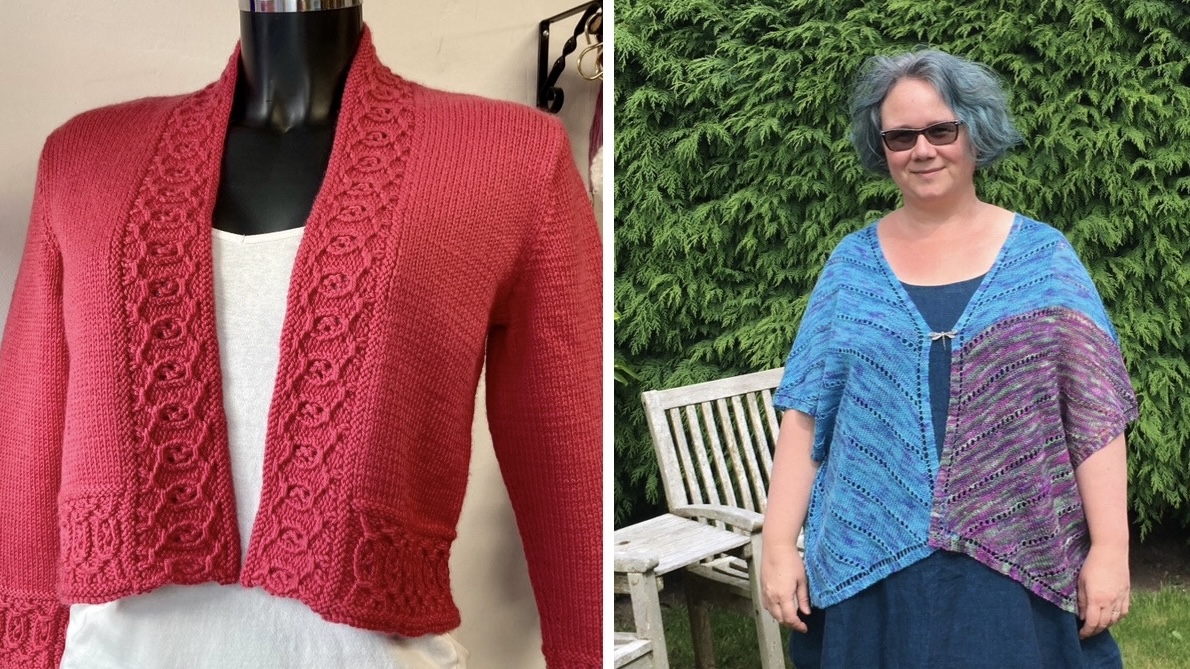
I had a fab conversation with someone who was partway through their What Do Points Make? and wanted a little reassurance that it was looking correct and what part of the garment they were working on. They had the project with them and it was wonderful to see the design being knitted up in that knitter’s own hand-spun yarn, a bit thicker than 4-ply and creating the most amazingly soft and textured fabric. I was glad to be able to say it was all perfectly on track and I could compare it to the sample I was wearing to show them what part of the garment they were working on and how the construction ‘worked’. One of the amazing features of What Do Points Make? is that you can make an entire garment from less than 100g of laceweight yarn (or 150g for the largest size as shown in the picture with the blue and purple sample).


Lichfield is a garment that really catches the eye. It might be the colour, it might be the design or the fact that it’s waist-length, but it always gets comments. Some people love a seamless garment, some folk like to knit a garment in pieces and seam it. Lichfield is made in pieces, which are then blocked, the shoulders joined and stitches are picked up all up one front edge, along the neck and down the other front edge in order to knit the neckband. Sue has become really good at saying to folk that if they want to increase the length they just need to add multiples of 4 rows to the length before the armhole (that way the pick-up rate for the neckband is unaffected).
I find that one of the most common questions I get is about the sizing – possibly because the sample size on display is small. It’s Size 2 in the pattern which is to fit Size 8-10. Yes, the pattern is designed for UK4 – UK42. No, not 42″, Size 42. I’ve started giving the inch measurements as well, as people tend to be able to relate to that more immediately. So, the largest size is to fit a 64-66″ chest, with a finished garment size of 68.25″, without including the opening at the front of the jacket. Which makes it more like 70″+ finished chest. I know that still won’t cover absolutely everyone’s requirements, but it’s a pretty good range I think. When it’s cooler weather and I’m wearing my version in a larger size it’s easier for folk to see how the design scales up and imagine how it might fit them.


This is the info on the front page of the pattern:

The day after the Pop-Up Wool Show we travelled down to the midlands to start packing Mum up for another move, which took place the following day. She’s only moved 2 miles, but any move is an upheaval. I think she’ll enjoy the new place a lot once she gets used to all the new stuff. We drove back home again last night with a very heavy bed frame in pieces in the car. Needless to say, that stayed in the car until this morning! If today’s post has any typos that I’ve missed – I apologise in advance…!
Our next show is going to be Yarn Gathering! I can hardly believe that it’s coming round so quickly, but it’s now less than 4 weeks away.

Do come! One of the risks with a free entry event with no tickets is that we have no idea how many visitors will come through the door on the day. We’ve been lucky so far that folk have responded to our social media advertising and posters in local shops and other venues and I would love it if this year is just as good. Anne from Yarn O’clock and I are working on the floor plan this week which will be fun. The first thing is to work out which floor each exhibitor will be on – I know straight away that the large floor loom for the Iron Age weaving demonstration will need to be on the ground floor!
I still need to pick the raspberries that are ripening fast at the bottom of the garden, but as I said, it’s been a busy few days. I read very recently that a lot of fruit is ripening early this year, not because we are having an early autumn, but because the trees and plants are under stress from the lack of rain and the multiple heatwaves. Ripening fruit early is an insurance plan in case the main plant doesn’t make it.