Posted on Leave a comment

Advent – a time of waiting

On Sunday I sang at the Advent carol service at the church where I am a member of the choir. There was quite a bit of plainchant (we did the Palestrina Advent Responsory and the ‘Great O Antiphons’ as well as the much more modern The Lamb by Taverner and some good solid advent hymns. Before the service began the rector said there were some children in the congregation in Christmas jumpers and that perhaps they thought they were going to get Christmas carols rather than Advent carols. They are very different! Advent is a time of waiting and anticipation.

A tradition here is that we put our Christmas tree up on Advent Sunday, so it is now in pride of place in the lounge, complete with lots of decorations. Some are new, some are as old as I am. Some are homemade and some are bought. There are even a couple of glass baubles she and Dad bought when they were first married. Putting the tree up and decorating it (two separate things!) always takes much longer than we expect, perhaps because it also involves moving furniture to other rooms in order to make room for the tree! We now have an armchair in the kitchen and a rocking chair in the front room where I teach. The other result of having put the Christmas tree up, is that I know realise I will have to wait until it comes down again (on January 6th) to block my 4ply What Do Points Make? as there simply isn’t enough floorspace anywhere at the moment. Another example of Advent being a time of waiting and anticipation, perhaps!?

Later today I will be getting my sewing machine out as I have some mending to do. A couple of months ago we were re-arranging the front room ready for piano lessons and I caught the pocket of one of my smocks under the radiator. I have been meaning to mend it ever since.

And then in the past couple of weeks I have discovered that two of my skirts are going on a seam and one of my favourite dresses has a hole developing so I really need to get these things fixed.

Of course, these are all garments from The Slow Wardrobe and I have had them for years (I think you can tell that in the case of the purple skirt), but I want to keep them going for several more years. It’s all the more important as Linda has moved to France and isn’t currently selling any new clothes! I really can’t imagine wearing anything else on a day to day basis. I can’t decide at the moment whether to patch the dress or try to darn it. Any suggestions welcome!

Making Tracks is now out in issue 222 of The Knitter! It looks great on the model.

This is the jumper I was writing about earlier in the year where it took me three tries to get the sleeves exactly the way I wanted them. The yarn quantities are quite large because it was designed as a man’s jumper and therefore the body and sleeves are longer than might be expected in a woman’s garment. As long as you have completed all the sleeve increases you can make the sleeves the length *you* want them to be. The same goes for the body. When I republish this as an individual pattern in six months I think I will add in additional length measurements for body and sleeves for female sizing charts as well, and include yarn quantities if following these length measurements.

The knitted gnome is complete and will be delivered to his new home at the end of the week. I’m very pleased with how it turned out! I think I will make one for us to keep as well, maybe reversing the colours.

I completed my tech editing course last week!

As well as this badge I have a certificate and now I just need some people who would like me to edit their knitting patterns!

Our final yarn show of the year is happening soon! On Saturday December 13th we will be at Yuletide Yarnies at Shrewsbury Flaxmill Maltings. There will be mince pies and live music too! £5 for advance tickets bought online or £7.50 on the door.

Posted on 2 Comments

A Stitch in Time

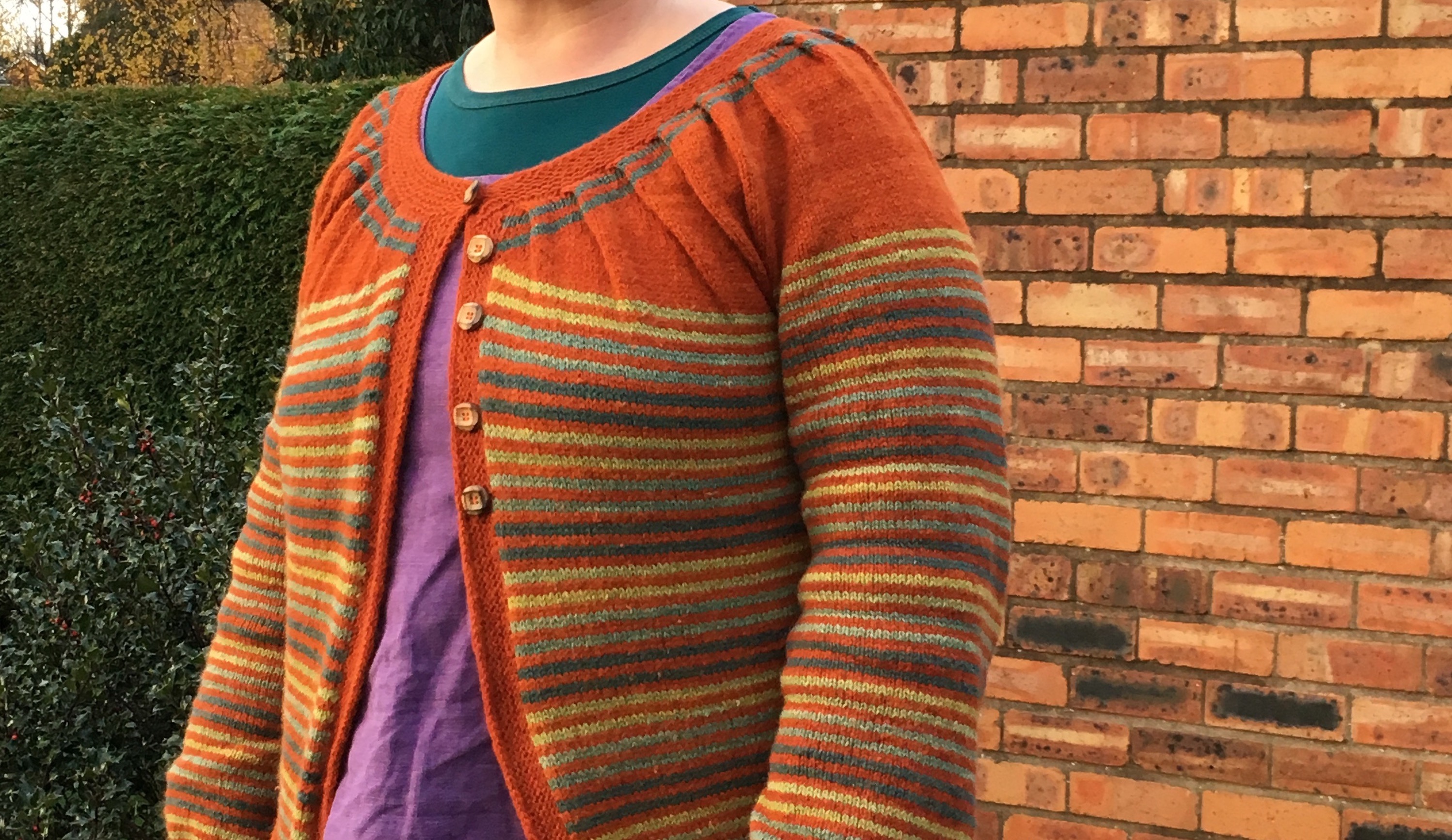
I finally finished this cardigan (Manu by Kate Davies) in August 2018.

Before I got to the stage of being able to wear it there were a few false starts – I needed to make it two sizes bigger than I had begun in order for the sleeves to fit (and to fit over the roomy dresses and smocks I love from The Slow Wardrobe) and also it was originally going to be all orange.

However, the skeins of yarn I was using (Shilasdair Luxury DK – now discontinued) are hand-dyed and dyed with natural materials at that (Madder root for the orange) and so, although I thought I had matched the colour of the skeins well when I bought them at Wonderwool in 2017 it turns out they weren’t similar enough. I could have switched between two skeins of orange every other row as is recommended with hand-dyed yarn, but I didn’t. The point at which I was getting going with the second skein was also the point where I realised I was knitting the wrong size. Which meant I didn’t have enough orange yarn anyway. So, I decided to do the recommended striping, but with other colours!

Many who know me will say that I can be quite indecisive at times (and at others, so not!) and so it was that, although I was pretty sure it would work really well with three colours striping through, I couldn’t decide which additional colours to use. I think I bought seven. The others are still waiting patiently in my stash.

I loved the narrow stripes and the way they repeated up the body. Especially the way the short rows at the back of the neck separated the final set of green stripes from the rest of them. It did, however, result in lots of extra ends to weave in!

Rear view of me wearing a recently finished Manu in the garden.

I also discovered that my knitting and purling tensions are not the same. The body is worked flat (knit one row and purl the next) and that was made first, as far as the armholes. I wanted the stripes on the sleeves to line up with those on the body. The sleeves are worked in the round (knit every round), but my stripes were not matching up. Turns out my purl stitches are tighter than my knit ones, so the stripes on the body were ever so slightly narrower than the sleeve stripes. The solution? Rip the sleeves out and try again with a slightly smaller needle. Fortunately that worked, or my whole striping plan would have been out of the window.

You can see that this cardigan took quite a lot of effort to come into being. So, when it started to wear thin under the arms on the body and the sleeves I had to do something about it. I got the spare yarn out and duplicate stitched (sewed over the knitted stitches, recreating them exactly) large patches of the fabric, maintaining the original striping. It took a long time and, again, there were a lot of ends to deal with. But it worked and the reinforced fabric looked brand new again.

The reinforced areas under the arms show up as darker patches when held up to the light.

Unfortunately parts of the reinforced areas are now wearing thin again and I’m not sure if working a third layer of yarn through those stitches will help or damage it further. I noticed this yesterday when I was working on the cuffs.

The whole body of the cardigan and the cuffs are worked in garter stitch edged with i-cord which gives a beautiful piped effect. But it’s not very stretchy, at least not with the yarn I had used (10% baby alpaca, 10% baby camel, 40% angora, 40% merino lambswool) which in itself does not have a lot of elasticity. And I am a sleeve-pusher. I like wearing long sleeved garments, but if I need to wash my hands, make bread etc I push my sleeves halfway up my forearms. I also have a tendency to stroke the edge of my cuffs between the fingers and palm of my right hand. Both of these things had meant the i-cord had taken a bit of a battering and the yarn had snapped and worn out in a few places on the cuffs. A year or so ago I mended them.

A close-up of the ravaged cuff that had previously been repaired just by whipstitching over the frayed edges.

Last week I noticed they were in a state again and this time it was much worse, with patches of knitting that were starting to unravel. Luckily the cuffs were picked up and knitted after the sleeves were complete, so I would be able to re-knit them completely.

But then I thought, why? Why remake the cuffs in the same way they were before when it doesn’t suit how you need your sleeves to function? And so, rather than knit a new garter stitch cuff with i-cord edging I decided to do something different. After all, one of the signs of madness is supposed to be doing the same thing over and over again expecting a different result, right? This time I would make the cuffs as stretchy as I could.

I cut off the old i-cord and carefully pulled out the garter stitch back to where the stitches where picked up. In several places the yarn was only just holding together still.

The old cuff cut off lying on a wooden desk along with the unpicked remaining yarn looking like instant noodles. In front of this is the sleeve of the cardigan with three double pointed needles picking up the stitches prior to re-knitting the cuff.

I put the picked-up stitches back on the needles and counted them. 42. I was planning to do a two by two rib, so I needed a multiple of 4. I worked the first round adding 2 extra stitches and holding my breath that the original stitches I was working through would hold while I did so. Then I worked another seven rounds and decided it was time to cast off.

I needed as flexible a cast-off as I could find and remembered Jeny’s Surprisingly Stretchy Bind Off which I discovered in Knitty years ago. Because it had been so long since I had worked it I had to look it up again, but it proved to be exactly what I needed. Cast-off complete.

One new cuff and one old unrepaired cuff laid on top of each other for comparison, with an open MacBook in the background.

Once I had done the same with the other cuff and woven in the remaining ends, I had a cardigan I could wear again with pride (and much smarter looking cuffs than the old shabby ones).

Now I just have to think about what I will do when the patches under the arms wear through again…