
We spent last week in Kent visiting friends and family and the week culminated in going to see The Manic Street Preachers / Suede at Dreamland in Margate. It was very good, and you can read more about it (along with a fantastic Ronnie photo) over on my lovely wife’s blog, Singing as the Darkness Lifts and see why James Dean Bradfield shouted a “Thank you!” to us. She does an audio version too!
I had finished knitting my Bargello Aurora scarf before we left for Kent and I blocked it the day we got home. Yesterday it was ready for me to remove the pins and finish the ends off. I’m very pleased with it and I’m looking forward to taking some photos of it on Daisy (one of my dress form mannequins) later on today to add to the pattern.


The updated pattern will go live on all my platforms (Ravelry, Payhip, Lovecrafts and my website) on Friday, so you only have to wait three more days.
Since we got home I’ve also woven in all the ends on my Persian Tiles Blanket, designed by Janie Crow. It does need a final wash to allow the border and seams to relax and lie flatter, and I’m watching the weather forecast carefully to choose a consistently dry day to do this so it can dry outside.

This project has had so much attention on Twitter every time I’ve posted about it. I can only hope that one day one of my own designs will be admired as much!
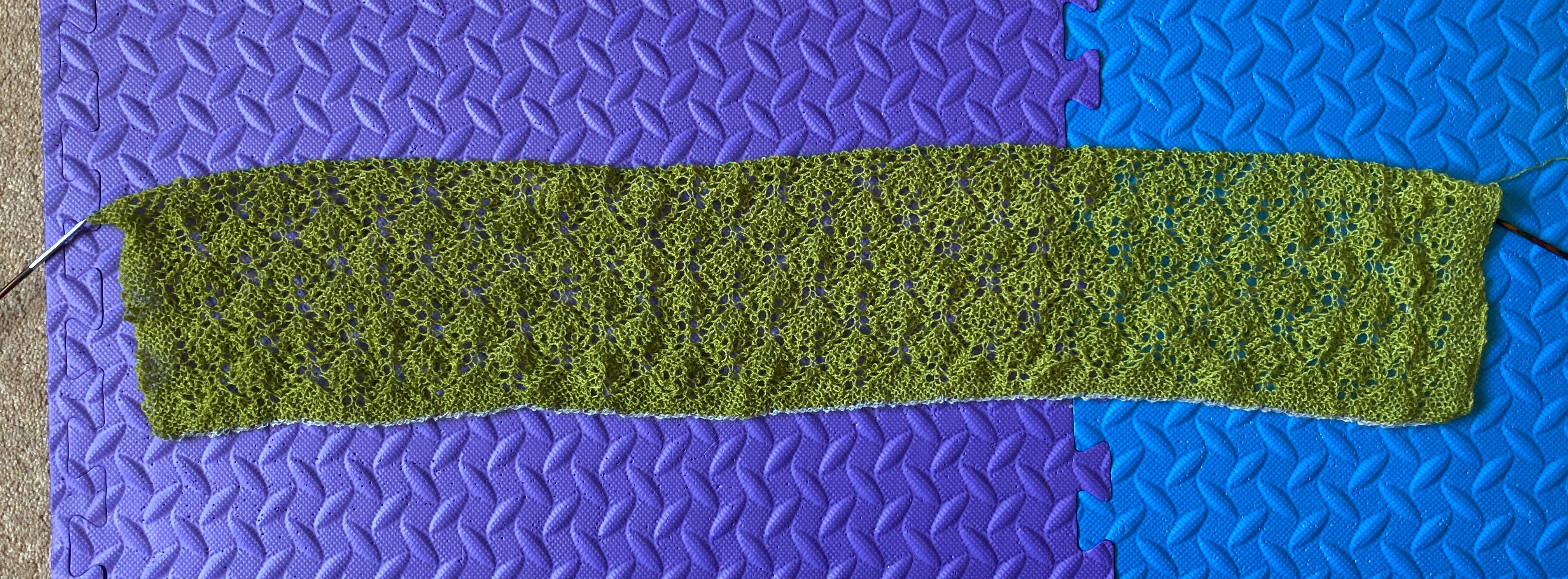
My new Elinor Hap Shawl sample is steadily growing. I’ve done three and a half pattern repeats of the 15 that make up the centre square so far. I’m enjoying knitting this one again and the finer lace weight yarn is giving a really soft fabric It’s rather wide with 191 stitches in this section, but then there’s just the border and the edging. The whole shawl uses traditional lace stitch patterns. The stitch pattern in the centre square is called Smiling Diamonds – once it’s been blocked you’ll be able to see why more easily!

For a while now I’ve been planning to run some Zoom Workshops and yesterday I finally booked them in! All workshops are 2 hours long, running from 7-9pm (British Summer Time/GMT+1) and cost £25 per person. I’ve put a 10-person limit on each the workshops so that people can interact and get the most out of it.
Zoom Workshops currently available are:
Introduction to Two-Colour Brioche Knitting – Tuesday 8th October
Fair Isle (Stranded) Knitting – Saturday 12th October
Next Steps in Two-Colour Brioche Knitting – Tuesday 22nd October
I’ll be adding these workshops to the Events page on my website later. The links above go straight to the relevant TicketSource page where you can see all the details and book a place if you wish.
I’ve been thinking about swatching a lot lately and have been doing quite a bit of it too.
Swatching as a designer is like playing and I love it. During our week away I had my squared paper and pencil out along with my needles and yarn, and knitted 7 different swatches around an idea I had until I finally cracked it with the 8th swatch. It wasn’t a random idea; I’m working on a submission for publication and there is a brief – techniques to include and a level of difficulty to provide, as well as specific yarns/colours they’re looking to use. I’ll be drawing up the submission document this week and I really hope it’s accepted. Of course, as these swatches are for a design submission I can’t show them to you, but I did enjoy making them and tweaking the idea until I got to the Goldilocks ‘just right’ moment.
The other type of swatching I’ve been thinking about is tension swatching. I know I’ve mentioned this before, but a knitter’s claim that they ‘always knit to tension’ and therefore don’t need to swatch before starting a project is so strange to me. They might generally turn out the ‘recommended tension’ on a yarn ball band, but that doesn’t mean anything when it comes to a pattern.
The pattern tension is the designer’s or sample knitter’s tension – it’s the number of stitches and rows that they got across 10cm/4in when working a specific stitch pattern on a specific needle. Any two knitters given the same needles and the same yarn are highly likely to knit to a different tension – sometimes wildly different. Even a small difference adds up over a larger piece of knitting and can even result in a knitter running out of yarn if they were unaware their tension was looser than that in the pattern, as it creates a larger finished item which inevitably uses more yarn.
Here are two swatches knitted by different people using the same yarn and needle size. The swatches themselves are different sizes because a different number of stitches were cast on and a different number of rows were knitted. It’s the size of the stitches themselves that is important.

I can see they look different, but perhaps not very different. It’s only the stocking stitch sections that will be measured – the borders are just to help the swatches lie flat and not curl up.
When measured the smaller swatch has 24.5 sts x 34 rows over 10cm and the larger swatch has 23.5 sts x 33.5 rows over 10cm. That sounds very similar, doesn’t it? It’ll be fine, won’t it? Not necessarily. Scale it up. Say it was for something that has 500 stitches. For the knitter of the smaller swatch that fabric would be 204cm wide, but for the knitter of the larger swatch the same number of stitches would be nearly 213cm wide. That’s a difference of 9cm in the finished items for the same number of stitches!
What’s the solution? It’s easy! Knit a tension swatch in the given stitch pattern and needle size (make it 12-15cm in each direction). Wash it and dry flat, or block more firmly with pins if the pattern says to. Then measure 10cm across the stitches and count them, and measure again down the rows and count them. Compare these numbers to the tension given in the pattern. If you get fewer stitches than the pattern tension states your tension is looser, so try again with a smaller needle. If you get more stitches your tension is tighter, so try again with a bigger needle. Wash and dry this new swatch and measure it. Stitch gauge (tension) is more important than row gauge as it’s harder to adjust around. Patterns often say “continue in pattern as set for another XX rows or until work measures XX cm”. This allows a knitter to adjust the number of rows worked if necessary to achieve the right length – this is much easier to do than adjusting the number of stitches.
So many knitters refuse to take the step of knitting and measuring a tension swatch, saying it’s a waste of time, but surely it’s more of a waste of time (and money) to knit a whole garment that doesn’t fit you, or to run out of yarn just before you finish (if your tension is looser) and then have to buy another ball/skein (if you can find it still for sale)? If you’re a knitter who is reluctant to swatch before a project, please give it a go! You might find it saves you time and money in the long run – and who wouldn’t appreciate that?
That’s all from me for today. Take care and do something that makes you smile this week. K x