
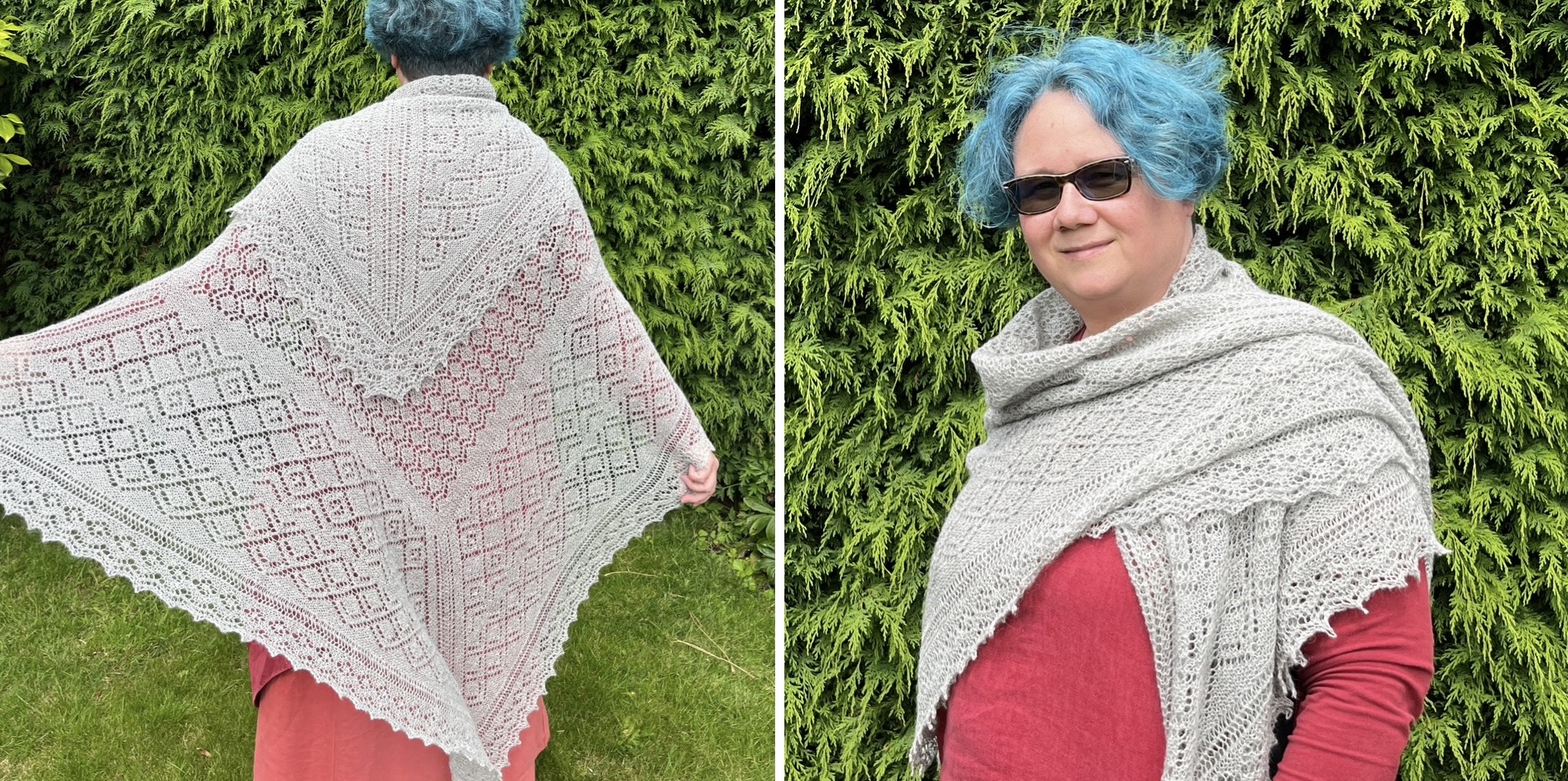
I am getting ready to launch Rhiannon Hap Shawl as a single self-published pattern later this month. Rhiannon was a great queen from Welsh mythology and this dramatic hap shawl is named in her honour.

Rhiannon Hap Shawl was first published in four parts as a Knit-along in The Knitter Magazine in the latter months of last year. As always occurs when a pattern is published in this way, I received emails from knitters eager to get their hands on a copy of the full pattern and in October I was explaining that folk had two options; to buy all four issues of the magazine as they came out to get each section of the pattern, or wait until late June 2025 when the rights would return to me and I would be publishing the shawl as a single pattern. And no, sorry, I couldn’t just email a pdf of the whole pattern there and then.
Last October, June 2025 seemed like such a long way off, but here we are! I am on the final checks of the layout of the pattern in my own house style and new photos have been taken. Next week I will be sending out an email to my newsletter subscribers with an exclusive introductory discount code to use on Ravelry, Payhip or my website, so make sure you’re on the list if you’d like one of those.
I thought I’d spend today’s blog post answering a few of the questions people have asked me about lace shawls and hap shawls in particular when we’ve been at yarn shows.
- What is a hap shawl? This is a great question and one I was asked at Yarnies at the Flaxmills in Shrewsbury last month. A hap shawl is a traditional structure for a shawl. It is square (and a half hap is a triangle on the diagonal of the square) and it is worked in a particular way. The central square is knitted first, then stitches are picked up all the way around the four sides of the square. These stitches are then knitted to form a border. In Rhiannon’s case there are two border patterns! Some hap shawls stop at this point and cast off, but you can also knit an edging. Rhiannon’s edging is a knitted-on edging that uses up one stitch from the border with every other row and works its way around all four sides with some fancy footwork to get around the corners. Once the edging is complete you cast off 16 stitches and seam the diagonal edges of the edging and border sections together.
- Is it hard to knit? Not really! All of the lace is created through yarn overs and just three types of decrease: K2tog (knit two together), SSK (slip 2 sts one after the other to the right needle then knit them together – which can also be worked as slip 1, knit 1, pass the slipped stitch over), and Sk2po (slip 1 st, knit the next two together, then pass the slipped stitch over). I agree with Woolly Wormhead that definitions of whether a pattern is difficult are very subjective, but I think if you can do these stitches, and want to make the shawl you will be able to! The central square has a straightforward repeated lace pattern that is a traditional stitch pattern. You do need to count your stitches carefully when you pick up around the edge for the border sections, but again, it’s a straightforward lace pattern that doesn’t involve any stitches that are too complex and there are lots of repeats! You do need to use a circular needle as there’s no way you’d get all those stitches on a straight knitting needle – and it wouldn’t work when you’ve got stitches that go around all sides of the square. The knitted-on edging is the only section that uses some lace stitches on the wrong side of the knitting as well as on the right side, but again there are no difficult stitches. It’s a 12 row pattern repeat so it’s easy to remember after a few times through! When you get to the corners, there are some short rows, but the pattern takes you through them step by step and explains which type of short row to use where.
- Do I have to be able to read lace charts? No! Everything in the pattern is written out as well as charted. If you are using the charts you do need to read the written pattern as well as there are a few ‘uncharted areas’ such as garter stitch sections between the stitch patterns.
- How do I block it? This is where you wash the shawl (gently), and pin it out to dry to stretch and open up the lace stitches. A shawl can grow dramatically during this process. I’m lucky enough to have a hap stretcher, pictured below (a traditional frame with nails around the edge that you can adjust to different sizes), but you can also pin the shawl out on a spare mattress or on the floor, if it’s covered in carpet. Don’t try pinning it out on a laminate or wooden floor! Another method folk use if they are short of space is to fold the shawl in half and pin it out as a double layer or even hang it on the washing line with pegs on the points. The washing line method doesn’t give as precise a finish, but it is a good back-up option.
- Do I have to use the same yarn as you did? No, you don’t. I knitted Rhiannon in laceweight 100% Alpaca yarn, but you can use laceweight wool or other fibres. In fact, this was the first time I had knitted lace with alpaca and I was holding my breath when swatching and blocking to see if the yarn would hold the stitch patterns – it does! My shawl used 220g/1760m of laceweight yarn on 3.75mm needles. You could use 4-ply yarn if you prefer, but remember you will need at least double the weight of the yarn to get the same meterage – and you might need slightly more length as well as weight. The fabric would be less gossamery, and more substantial, but you can still use the same size needles.

I’m sure there are lots of other questions I’ve been asked at yarn shows and events that I’ve forgotten about for the moment. If you have any other questions about knitting lace shawls, pop them in the comments and I’ll answer them!
I’ll update you on the progress of the veg seedlings next week. Until then, take care and remember to sign up for the monthly newsletter! K x
Hi Kath,
A beautiful shawl. I have some Shetland Lace Weight and 2ply would they be suitable do you think? My hands are troublesome so I don’t think I can manage it but with a 4th Great Grandson on the way it would make a lovely gift.
I think Shetland wool would be gorgeous for Rhiannon. Congratulations on the 4th great grandson on the way too!
Such a beautiful shawl!!!! You have worked up a piece of art that will be a treasure to pass to the next generations. If I can master this, my daughter will love it.