Posted on Leave a comment

Drawing a Line

Making Tracks was launched last week as an individual pattern as the rights returned to me six months after it was first published in The Knitter magazine. I have to admit that a heatwave (and one that was the UK’s hottest May on record) was probably not the best time to launch a cabled jumper, because although the pattern pages have had lots of views, no-one was in a jumper knitting mood and no copies have yet been sold!

Mind you, with the sudden change back to ‘more appropriate’ weather for the time of year – along with thunder storms and some very heavy showers – you never know! It’s cool enough now to start knitting a jumper and it would certainly be ready to wear by autumn.

I have been blocking something that I cannot show you – you’ll get to see it in October – but I’m pleased with how it’s come out and I’m looking forward to sharing it with you. I’ve just taken the pins out and left it to relax on the blocking mats as I want to see how much it pulls back in when no longer under tension.

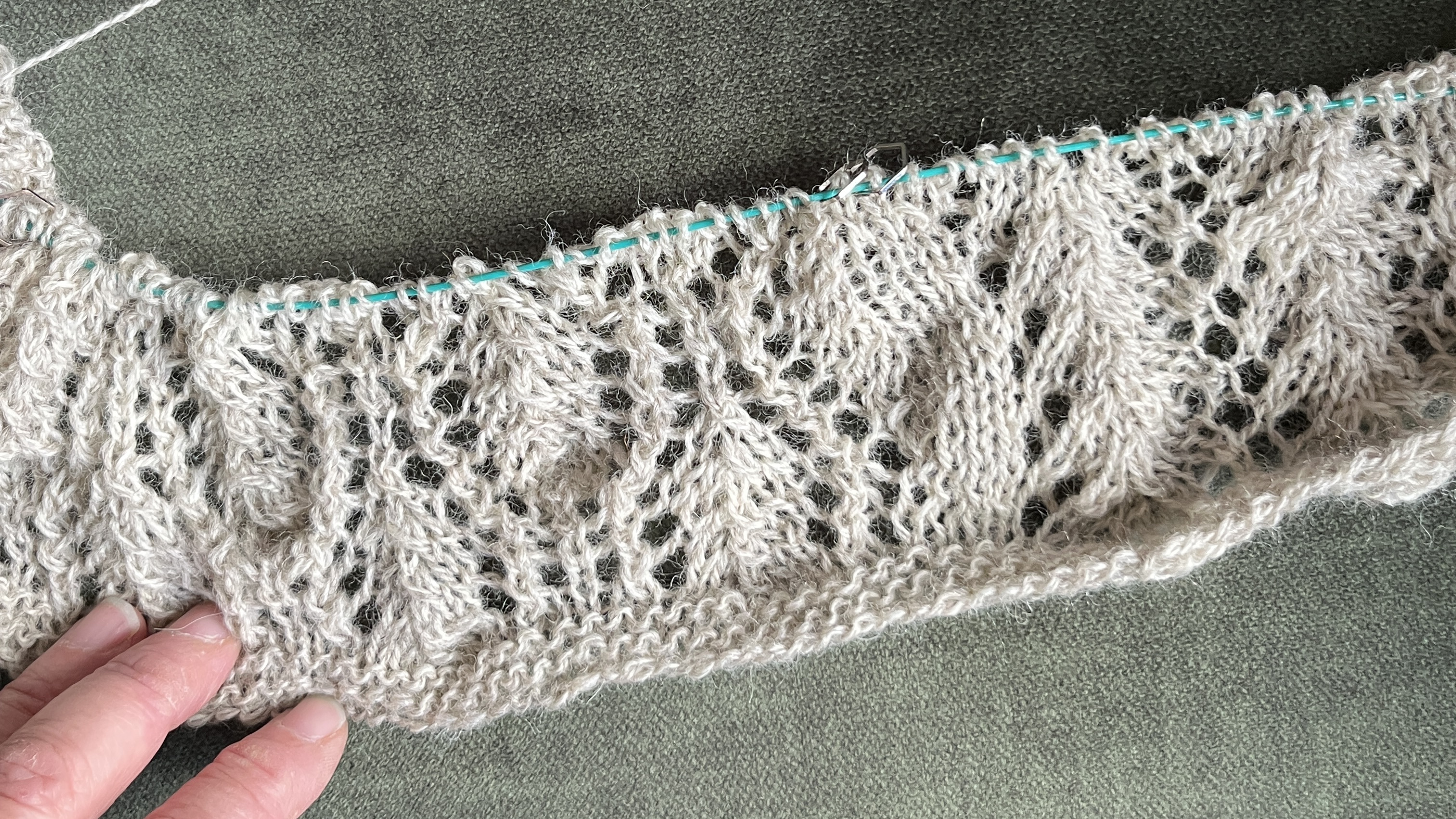
I’ve already been promising myself (and customers at yarn shows) that I would knit a sample of the short version of Leaf & Vine and I cast on this week. Because the short version still has quite deep armholes, I’m already halfway through the length of the body before I do the sleeve cast-on! Having been knitting longer garments recently, this seems really short, but I must remember that the length will grow when the lace is blocked and the overall measurements are good. I’m knitting it using a lovely light 4 ply yarn that I bought from Jo at Second City Yarns. It’s an undyed yarn in light grey.

I’ve been getting everything ready for our next show, which is The Wool Monty. This is held at Magna in Sheffield and is famous for being super inclusive. We received our lanyards, set-up info (including directions on how to get to the room I’m teaching in on Sunday morning!) and a copy of the show brochure through the post yesterday and I think it’s going to be an impressive event.

I’ve sorted out the kits, so I can bring a good range of kits in one big box, rather than bring absolutely everything in two! I’ve decided on the pattern inventory and printed anything that was needed, and I know that everything we are bringing will fit in the car. I’ve even ironed the black cotton double sheet that goes on the table. Now all I need to do is sort the sample bags out, so that the new patterns are in them and any samples of designs not going with us aren’t!

The weekend after The Wool Monty I am due to be teaching at Ewe Felty Thing once more. The last workshop (on Steeking) had to be postponed as not enough people had booked to make it viable for the shop to run, so I’m really hoping that some lovely knitters will want to expand their brioche knitting skills and/or learned how to use the stacked stitches technique, which is exemplified in the designs of Xandy Peters. If either of these workshops sound like fun to you – please do book a place and come along! There’s cake, drinks, biscuits and laughs as well as lots of knitting and top tips.

Here are just two designs you could knit with these techniques:

On the left is Meg March Shawl designed by me, and on the right is Fox Paws designed by Xandy Peters. Pictured is the scarf I knitted using this pattern (photographed before I wove the ends in!).

Brioche designs can be either very geometric or organic in their lines, but the key feature is how the main colour creates lines that can draw shapes. You’re using two colours, but one colour at a time, working each row once with the main colour (the light colour here), then once again with the background colour (the dark colour here).

Stacked stitches is a fabulous technique where, again, you only use only colour at a time. No stranding or bobbins of little colours, just a whole row of one colour that take wonderful twists and turns by working increases and decreases on top of each other – hence the ‘stacked’ in the name!

It’s struck me that all the pictures I’ve shared with you today have clear lines in the designs, just formed in different ways; through cables, lace, brioche and stacked stitches. It never ceases to amaze me how versatile knitting is and how we can create beautiful and detailed fabrics with just yarn and needles!

That’s all from me today. I’m hoping that I’ll have some photos of my grey 4 ply What Do Points Make? to share with you next week. I didn’t want to get ‘official’ pics taken until I’d refreshed the blue of my hair, but that is now done, so we are good to go (in between the rain showers!).

Take care and have a good week. I hope you get to do something you enjoy. K x
Posted on 2 Comments

Ready, Set, Go!

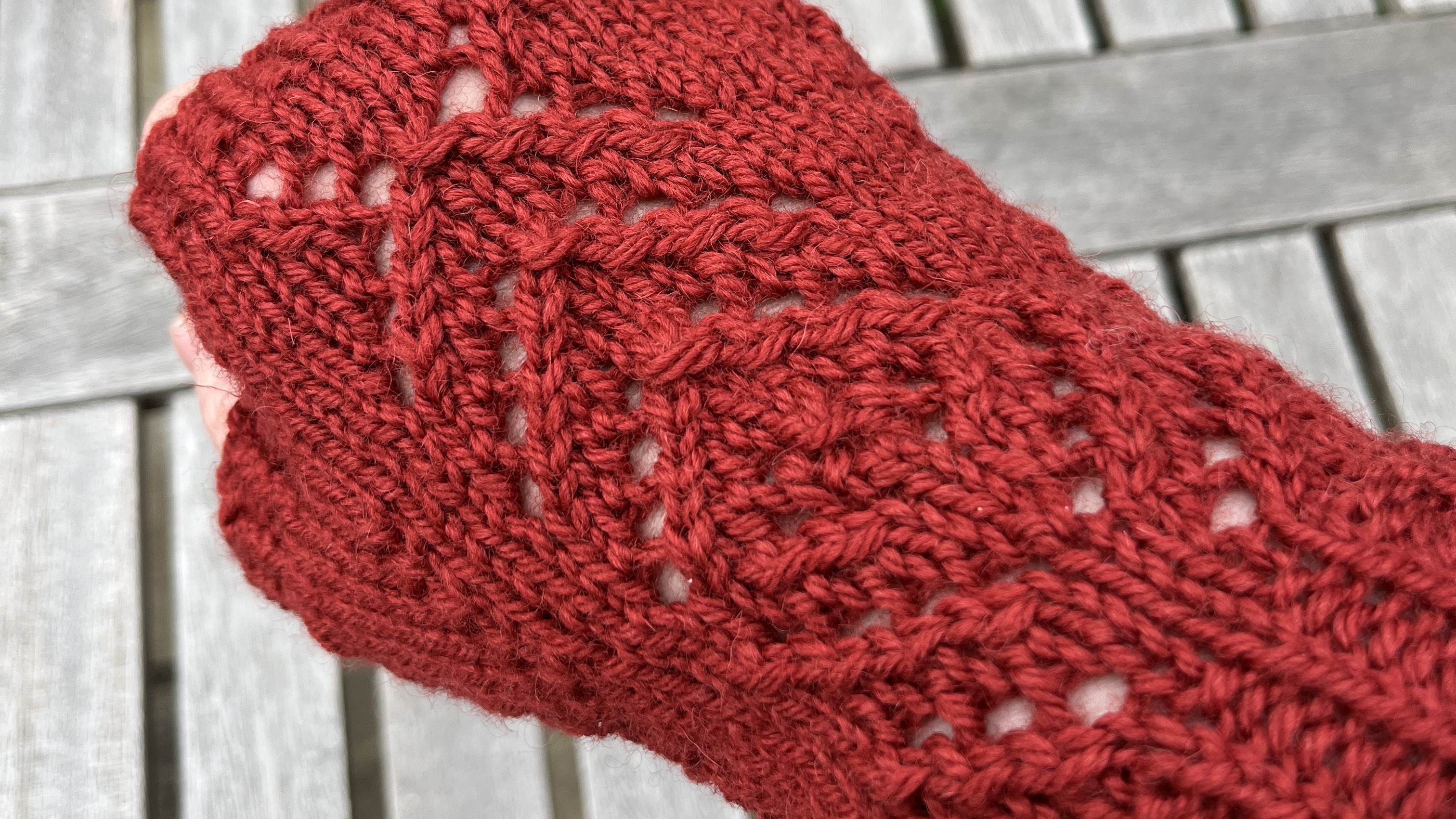
If you are a newsletter subscriber you may wish to check your inbox – there is a cheeky discount waiting exclusively for you to celebrate the relaunch of Ice Diamond Mitts. I’ve changed the yarn used to the gorgeous Welsh Cambrian Wool and knitted new samples in each size. The pattern has been re-written to make it clear and easier to follow and the lengths for each size have been slightly shortened, making the mitts easier to wear and also ensuring that even the largest size uses only 90m/45g yarn for a pair! You can seem from the photos that the smallest size still needs its ends weaving in and also that it looks really cool if you knit the ribbing in a contrasting colour! I did this partly to see how it would look and also because I didn’t have enough yarn of one colour that wasn’t red for a small mitt.

The photos on the wooden table are of the large size, the ones on the black background are medium and small.

Following hard on the heels of Ice Diamond Mitts will be my own self-published version of Making Tracks, which was first published last November in The Knitter. I just need to insert the charts into my own format of the pattern and add some of my new photos. The rights for this jumper return to me towards the end of this month and so I will have printed copies with me at The Wool Monty in June!

Making Tracks is a cabled men’s jumper with saddle shoulders and a round neck, knitted in pieces and seamed. The jumper is designed in 8 sizes (S-5X), with 10-12.5cm positive ease. Positive ease might sound ‘fancy’ but that just means how much bigger a garment is than your actual body measurements. If you had no ease on something it would be your exact body measurements. (If you have negative ease then the piece is smaller than you are, but hopefully stretchy enough so that it can be put on and then cling to the contours of your body). Positive ease on a garment means you can move in a garment and probably wear layers under it and approx 10cm (4″) is the amount of positive ease for a ‘standard’ fit to a jumper/top.

You may remember my mentioning that this jumper was modelled on a female model when published in The Knitter. It’s the same jumper and it was designed as a man’s jumper, but they didn’t have a male model available for the photoshoot. What those photos do show is that Making Tracks also looks good when worn by a woman. It gives more of a ‘boyfriend fit’ feel, and the sleeves are a bit longer than you might expect on a woman’s jumper, but it still works well!

If you want to knit this sweater for a woman you may wish to check the underarm length of the intended wearer. You can reduce the length of the sleeve easily as there is plenty of straight sleeve knitting between the increases and the point where the sleeve joins the body.

We had a day out yesterday, meeting up with some friends in Coventry. It was a super day. We visited the cathedral (both the bombed ruins of the old cathedral and the new cathedral next to it), walked, feasted and chatted lots. I recall going to Coventry Cathedral once on a school trip when I was quite young – and definitely too young too appreciate the beauty of the modern design when I had grown up going to churches that were hundreds of years old.

It finally occurred to me yesterday why concrete was a good idea for parts of the design of the new cathedral in Coventry. As well as being entirely fitting for the brutalist design, it was probably the only way to get the cathedral built quickly. Entirely stone built cathedrals can take more than a century to build. For example, Sagrada Familia in Barcelona is finally structurally complete with the final piece of the central tower being put into position in February this year (building work began in 1882 and Gaudi took over as chief architect in 1883!), but construction will continue for another decade. The design for Coventry Cathedral was chosen in 1952 by competition, the foundation stone was laid by Queen Elizabeth II in 1956 and the finished building was consecrated in 1962. So there were just 10 years from “this one please” to it being opened. That’s incredible. The building is also full of modern art on the floor, walls, windows and in sculpture. Even the way the organ pipes are positioned looks like a work of art. The 23m x 8m tapestry behind the altar is mind-blowing, not just in how it looks, but in how it was made – in one piece! That must have been one enormous loom!

The ruins of the old cathedral, bombed in 1940, are also a very powerful place. “Father Forgive” was ordered to be carved behind the altar by the bishop of the time. It’s amazing that so much of the outer walls, as well as the tower and the spire survived. The cross has been made with some of the burnt remains of the original building.

It was a visit to Lichfield (including visiting the cathedral) with these same friends that inspired my Lichfield cardigan. So, who knows, perhaps yesterday’s trip to Coventry will result in a new design?

That’s all for today. Have a good week, and I hope you get to do something you enjoy. Perhaps it will be casting on some Ice Diamond Mitts? K x