
Last week I shared a video with you on how to create a provisional cast-on using a crochet foundation chain. I showed you how to work the chain, pick up your knitted stitches from it and how easily it comes undone when you want to get rid of it. I also explained why you end up with one fewer stitch than you cast on when you’re picking up from a provisional cast-on.
That video is now on my YouTube channel as Provisional Cast-on Part 1 of 3, along with Part 2 which is a short video showing you how to crochet the provisional cast-on directly onto the knitting needle, thus avoiding the step of picking up the stitches from the foundation chain.
Provisional Cast-on Part 3 of 3 is a how-not-to video! This shows you why it’s a bad idea to just work a regular knitted cast-on in waste yarn and then change to your main yarn. Basically, it’s a right royal pain to undo when you come to free your stitches from the provisional cast-on! In my video I have to unpick the waste yarn bit by bit and even snip it with scissors to get it out (I did put my knitting needle into the stitches I wanted first before doing this).
I’m really surprised to see that even though these videos only made it onto my Youtube channel yesterday (there was a delay because my caption software decided to sulk and not work for a few days), they’ve already had some views!
Why did I do three videos on the same thing – especially since one of them was “don’t do it this way”?
Well, I’ve been talking about Rhiannon Hap Shawl being relaunched recently and last week I talked about it starting with a provisional cast-on and how to do it. I remembered that one time a number of years ago I was making something that needed a provisional cast-on, but I hadn’t done one in ages. I thought I just needed to cast on in my usual way with the waste yarn and it wasn’t until I came to undo the waste yarn (after knitting quite a lot!) that I remembered this wasn’t the way to do it. I had a lot of stitches to deal with and I wasn’t as experienced as I am now, so wasn’t able to get around the issue as I did in the Part 3 video, by putting the stitches I wanted on the knitting needle first, then slowly unpicking and snipping the waste yarn to get rid of it. So what did I end up doing back then? I ripped the whole thing out, went to look up how to do a provisional cast-on properly and started again from the beginning. If you’re going to knit Rhiannon or any other pattern with a provisional cast-on, I want you to be able to avoid this stress! I’ve added a link for Part 1 of the video to my pattern pages as well for this reason.
If there’s a knitting technique or stitch you would like to see a video of, let me know! Sometimes seeing something done and being talked through it at the same time can make all the difference. By the way, did you know ‘Show Me‘ is a brilliant song from My Fair Lady? If you didn’t, have a listen, it’s great!
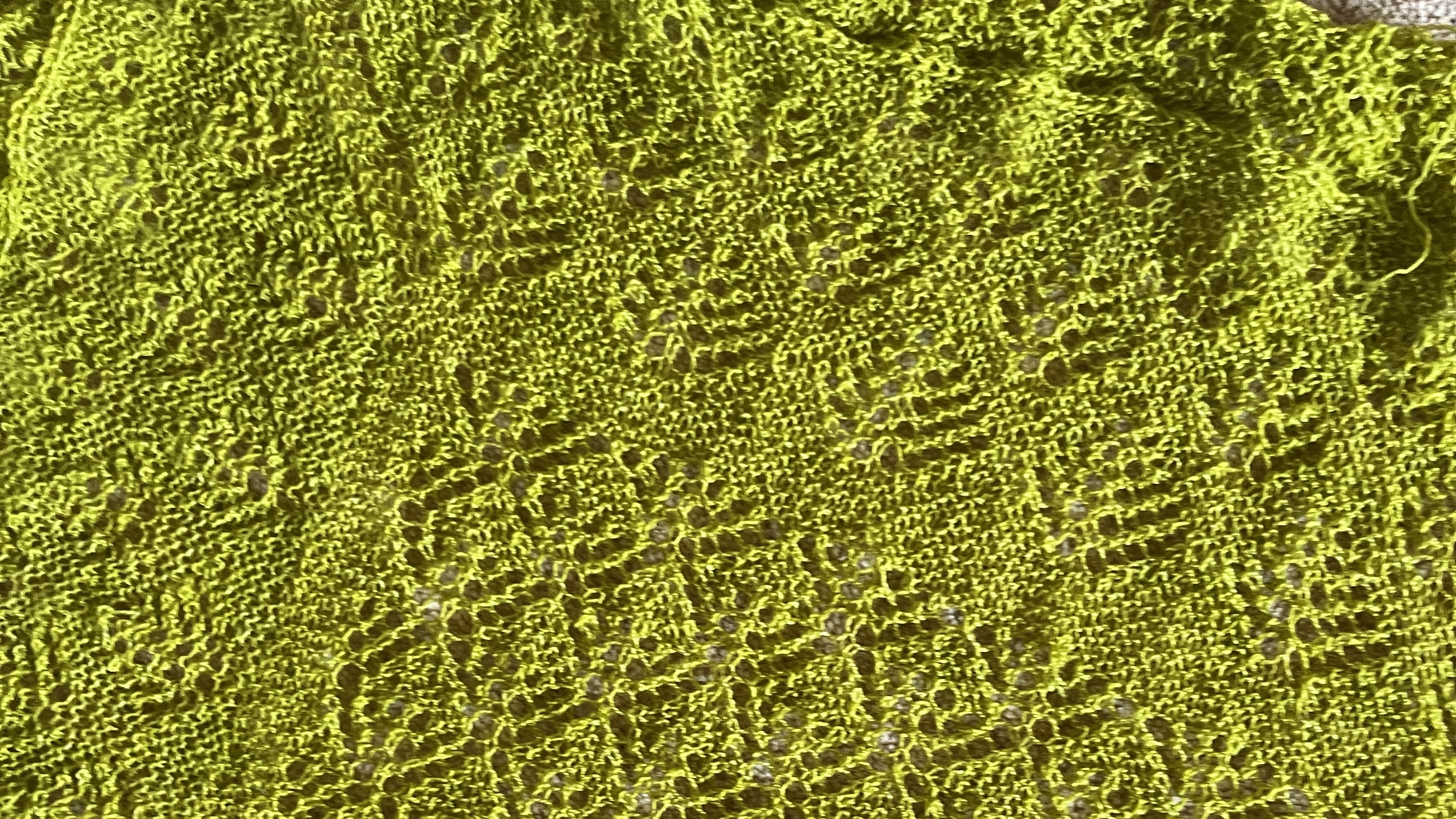
Do you remember me telling you about Elinor Hap Shawl, that I’ve been knitting a new sample for? I finished the edging! Quite a lot of that was down to my lovely wife doing the driving for a couple of long distance trips this week which enabled me to knit in the car. Though I have to say the concrete on the M54 is not a lovely surface when you’re knitting lace!! I’m going to share an unblocked photo of it here, and video the blocking process using my hap stretcher so you can see how it works. With any luck I’ll get that recorded for next week. The actual colour is somewhere in-between these two photos!


Elizabeth from Sew Woolly sent me a lovely thing she’d read in a book last night and it’s perfect to share with you while we’re talking about lace knitting:
“The future belongs to those who believe in the beauty of their dreams”. Marie Curie
This is surely the motto of designers who work in knitted lace. It can only be faith alone that drives them, because before it is stretched and blocked, lace in progress often resembles Chinese noodles.
I will reserve judgement on my lace in progress until the magic of blocking has worked its charms.
I have no idea which book this comes from, but it’s very true. Lace knitting only reveals its beauty when it’s been blocked. This is partly why I start my lace knitting workshop with a demonstration of blocking a knitted lace swatch: it’s dry by the end of the workshop and it’s really clear to folk how different it looks at the end than it did at the start!
I’ll also let you into a secret regarding designing with lace: that’s why designers swatch a lot! We’ll knit a small sample of a stitch pattern (though not too small!) and block it to see what it will really look like. It also helps us try out different yarns and needle sizes to see what is the best combination of stitch/yarn/needle for what we’re trying to achieve.
The new design I’m working on now isn’t lace and it isn’t a hap shawl! It’s stranded knitting (often called Fair Isle) which I haven’t used in a design for a while and I’m really enjoying playing with the charts and planning it. It’s an accessory for the home rather than a garment and it’s small enough to be a good piece for people trying out stranded knitting for the first time. I’m looking forward to sharing it with you in a couple of months time!
I made an exciting discovery in the garden the other day. As well as the one nibbled broad bean plant that is hanging on for dear life in the veg patch, there are two French bean plants on the other side of the currant bushes. (Please excuse the weeds!)


I had forgotten we had planted the seeds near canes that are permanently in place to stop us treading on our rhubarb while it tries to establish itself, and the beans have grown, twisting round each other before finding one of the canes (how do they do that?!) and making their way up it! I’m hopeful that they’ll survive long enough that we’ll get flowers and some beans from these. I still need to pick the blackcurrants and redcurrants and the rest of the gooseberries, but I haven’t been able to find time to do it yet. I think we may need a small chest freezer for all this fruit if I can’t turn it into jam, jelly or crumbles quickly enough!
That’s all from me today. Take care and, if you get a chance, do something that makes you happy this week. K x


